How to Trade a Meme Coin in 2026 and Turn a Single Position Into a Five-Figure Result
You can order the same kind of articles for your own video to boost it on YouTube and Google. Just message the Telegram bot @sat_sit_bot. Articles with your video embedded are written and posted by the bot itself — on popular topical sites (no ads). Try it free: 50 articles on us.
· based on the channel Megga
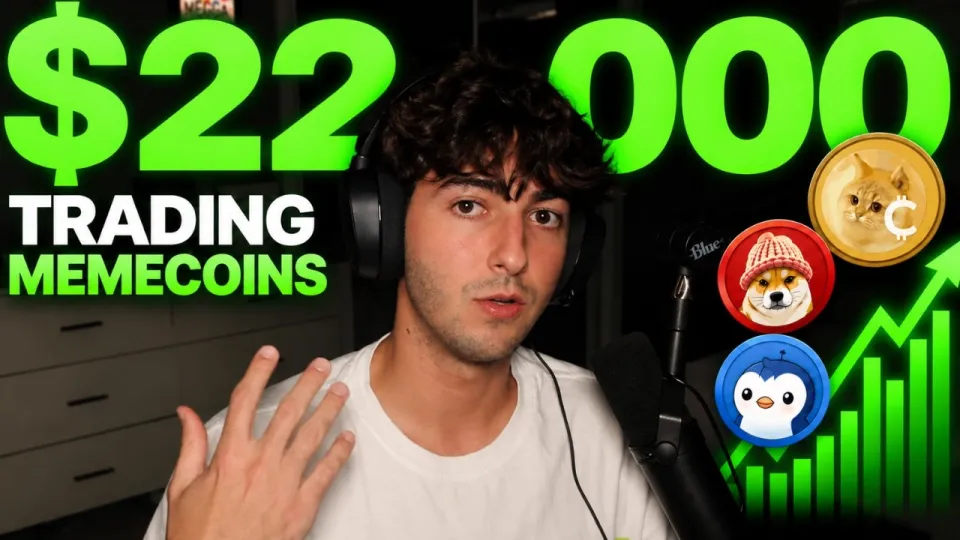
A meme coin trade is a short-horizon position in a low-cap token whose price is driven mainly by attention, liquidity and holder behavior rather than by cash flow. In the breakdown published by Megga, one such position produced a $22,000 result, and the useful part of that number is not the token but the structure around it: a funded wallet, a defined entry, a size that survives a full loss, and an exit executed before the crowd. Beginners who want the groundwork first can start with the free beginner trading guide on Whop, which covers wallet setup and the basics before any capital is committed.
What a meme coin trade actually involves in 2026
A meme coin trade is a bet on liquidity and narrative, executed on-chain within minutes or hours, and it fails far more often than it works. The mechanics are simple: a wallet holds SOL or ETH, a terminal or aggregator routes the swap, and the token contract determines whether the position can be sold at all. What separates a $22,000 outcome from a $200 loss is rarely the pick itself — it is the size of the position relative to the bankroll, the speed of the exit, and the willingness to take a loss without re-entering out of frustration.
Three things decide the result before the trade is even placed:
- Wallet hygiene. A dedicated hot wallet with only trading capital, never the main holdings, and a habit of revoking approvals after each session.
- Contract checks. Mint authority revoked, freeze authority revoked, liquidity locked or burned, and holder concentration that is not dominated by a handful of wallets.
- Exit plan written in advance. A target multiple, a stop level, and a rule for what happens if the chart stalls — decided before the buy button is pressed.
The numbers behind a $22,000 single-trade result
A five-figure result on one meme coin position implies a large multiple on a small initial stake, and that math is worth spelling out. If a trader turns $1,000 into $22,000, that is a 22x; if the starting stake was $500, it is a 44x. Both are possible on low-cap launches, but both require selling into real demand — paper gains on a token with thin liquidity are not $22,000 until the sell orders fill.
The practical lesson is that position size determines whether a 20x is life-changing or irrelevant. A trader risking $100 on a 20x makes $2,000; the same call with $1,000 at risk makes $20,000 but also accepts a $1,000 loss if the token rugs. Most traders who chase the headline number skip this step and size up after a win instead of after a proven process.
How to structure a meme coin trade step by step
Structuring a meme coin trade means deciding capital, entry, invalidation and exit before the token appears on screen, so the decision is mechanical rather than emotional. The workflow below is the one that scales from a $50 test to a meaningful position.
- Set the risk unit. Cap any single meme coin position at 1–5% of trading capital. A $2,000 bankroll means $20–$100 per attempt, which allows dozens of attempts before the account is impaired.
- Fund a separate wallet. Move only the risk capital on-chain, keep gas or priority fees available, and never connect the wallet to unknown sites.
- Screen the contract. Check mint and freeze authority, liquidity lock status, top-holder share and whether the deployer wallet has sold.
- Enter in tranches. A first buy on the initial move, a second only if the chart holds structure; averaging down into a falling meme coin is how small losses become total losses.
- Take profit in pieces. Selling 30–50% at the first target locks in the result and turns the rest into a free carry position.
- Log the trade. Entry, exit, multiple, reason for exit — the log is what turns a lucky trade into a repeatable method.
Execution itself usually runs through a dedicated terminal; the one referenced in the breakdown is Padre, which bundles charting, quick buys and wallet tracking in one interface.
Common doubts about meme coin profits
Doubts about meme coin profits are usually about whether the result is replicable, and the honest answer is that context matters as much as skill. A trader with a network of wallets and a following sees different flow than someone trading alone from a laptop — faster information, earlier entries, and more exit liquidity when the position needs to be sold. That does not make the method fake, but it does mean a solo trader should expect a lower hit rate and should judge the process on a month of small trades rather than on one screenshot.
A second common doubt is scale. Many traders ask whether the same approach works with $25–$100 stakes, and it does — the mechanics of contract checks, entries and exits are identical. What changes is the emotional weight of the trade, which is exactly why small stakes are the right training ground. A third doubt concerns newer token types such as tweet coins and community or profile coins, which follow different launch mechanics and liquidity patterns and deserve their own study before capital is committed.
Risk rules that keep a meme coin account alive
Risk rules are the only part of meme coin trading that a trader fully controls, and they matter more than any single pick. Low-cap tokens can lose 90% of value in minutes, and a contract can be modified or drained before an exit is possible, so every position should be sized as if it could go to zero.
- Never risk rent money. Only capital that can be lost entirely should touch a meme coin wallet.
- Assume the worst case is total loss, not a 30% drawdown.
- Cap the number of open positions so attention stays on the charts that matter.
- Stop after two consecutive losses in a session; revenge trading is the fastest route to a zero balance.
- Withdraw profits to a separate wallet or a stablecoin after a large win, so one bad trade cannot erase the result.
All links from the breakdown
All resources referenced in the guide are collected here: the free beginner trading guide on Whop, the Padre trading terminal, and Megga's channels on Twitch, TikTok and Twitter.
Final takeaway on trading meme coins
A $22,000 single meme coin trade is a real outcome, but it is the visible tip of a process built on small risk units, contract checks and disciplined exits. The transferable part of Megga's breakdown is not the token or the multiple — it is the habit of deciding size and exit before entering, then logging the result either way. Traders who start with $25–$100 positions and a written plan will learn more in a month than those who copy a large bet on the first day. For the groundwork, use the free beginner guide on Whop and treat the first weeks as tuition rather than income.
Key takeaways
- Megga's breakdown shows a single meme coin trade producing a $22,000 result on one position.
- The free beginner resource linked in the video is the Wiredd guide at whop.com/wiredd, and trades are executed through the Padre terminal.
- Meme coin outcomes come from position sizing and exit discipline, not from finding more tokens.
- A realistic test of any meme coin strategy is running it with small $25–$100 stakes before scaling up.
- Trading alongside a group of known wallets can inflate results, so a solo trial month is the honest benchmark.
Source: How I Made $22,000 in a SINGLE Memecoin Trade (FULL GUIDE) · Markdown version
Questions & answers
How much capital do you need to start trading meme coins?
You can start with $25–$100 per position as long as it is money you can afford to lose entirely. The risk unit matters more than the total bankroll: capping each trade at 1–5% of capital lets you survive a long losing streak while you learn contract checks and exits.
Can a single meme coin trade really produce $22,000?
Yes, if a small stake catches a large multiple and the position is sold into real demand. A $1,000 entry at 22x, or a $500 entry at 44x, produces that figure, but thin liquidity means paper gains only become real money when the sell orders fill.
Why do some traders get better meme coin results than others?
Access and information flow matter: traders with a network of known wallets and a following see launches earlier and have more exit liquidity when they sell. A solo trader should expect a lower hit rate and judge the method over a month of small trades rather than a single result.
What should be checked before buying a new meme coin?
Check that mint and freeze authorities are revoked, that liquidity is locked or burned, and that a few wallets do not hold most of the supply. Also confirm the deployer has not already sold, and decide your exit targets before you press buy.